The fact that today’s high was -67 degrees at the South Pole is not news. Especially for the 49 hardy souls overwintering; they knew what they signed on for. Nor is it a shock that it was -97 at Vostok one day last week, since the Russian base holds the record for the coldest temperature ever recorded (-128).
But there are some surprises being reported from the deep-deep south during the continent’s long, cold winter (which lasts eight months, roughly March through October). Like that alien species are invading and that declining penguin numbers may have less to do with warming temps than previously thought. And that the ozone hole over the continent increasingly influences the southern hemisphere’s weather and that the ice around the continent’s edges is melting faster than predicted. And that for the first time in a decade tourist visits to Antarctica are expected to dip dramatically in the coming summer season.
1. The aliens worrying Antarctic observers are not of the cellophane-skin and pumpkin-head variety, but rather more garden variety: Insects, slugs, worms, plant seeds and fungi that sneak in with the fruits and vegetables consumed by the 4,000 scientists who call Antarctica home during the summer season. Tourists are contributing too, carrying plant seeds in on their shoes and clothing. The invasion is encouraging calls for new levels of “biosecurity” to protect the otherwise pristine continent from being further infiltrated. For the moment, simple fungi and mold are the greatest concern because they often carry plant diseases: On the 11,250 fruit and vegetables sent to nine research stations researchers found soil on 12 percent of the food as well as 56 alien invertebrates and 19 different species of mold. On Antarctica’s near islands, rats, mice and cats are already devastating bird populations, a risk the mainland doesn’t have to worry about … for now … since warm-blooded creatures have a hard time surviving sub-sub freezing temps. For now.
2. Everything from burning fossil fuels and rain forests to cow farts are blamed for the planet’s changing climate. Now a team from Columbia University suggests the ozone hole growing over Antarctica is linked to warmer, wetter weather reaching all the way north to the equator. Initially discovered in the 1980s and blamed on the use of chlorofluorocarbons (CFCs) in refrigerators and aerosols, since their banning it’s expected the hole will largely close up by the middle of the century. In 2000, NASA satellites measured it at 11.5 million square miles; a decade later it had been reduced to 8.5 million square miles. Despite the shrinkage, the study blames the high-altitude ozone hole for contributing to higher wind speeds, leading to more intense storms and for heavy summer rains across eastern Australia, the southwestern Indian Ocean and the South Pacific.
3. It has been widely reported (including by me) that the Adelie penguin population in Antarctica has dropped by as much as 50 percent in recent years. The blame has been placed largely on the fast-disappearing ice along the edge of the Antarctic Peninsula, which had long been home to thriving penguin populations. The reasoning has been that as the average winter temperatures along the Peninsula have risen by 9 to 11 degrees since the mid-20th century, compared to 2 degrees everywhere else on the planet, the habitat change was chasing the ice-loving Adelie’s further south, or killing them off. But new studies by NOAA and the Scripps Institute of Oceanography suggest that might not be their numbers are declining, but rather because their main food source – krill – is diminishing thanks to warming seas, a recovering whale populations and overfishing. The two-inch long, shrimp-like crustaceans are the basis of Antarctica’s food chain but along the Peninsula it’s estimated krill density has declined by 80 percent. Warming temps, of both air and sea, will continue to take a toll as will man’s growing demand for krill: In 2009-2010 more than 202,000 tons of krill were taken, a four-fold increase over 2002-2003.
4. It looks like penguins and krill alike will have to adapt to even warmer temps and less ice far sooner than expected. A new report out of the California Institute for Technology and NASA’s Jet Propulsion Laboratory suggests that the big ice sheets in Antarctica and Greenland are melting faster than previously predicted. If nothing changes – i.e. dramatically less-burning of fossil fuels and far fewer cow farts – that will make melting ice the biggest contributor to sea level rise, outstripping the melting of mountain glaciers and polar ice caps. The report suggests a 6 inch rise in sea levels around the world by 2050, sounding even more worrying alarm bells than the 2007 study by the International Panel on Climate Change, the last international body to fully assess the future of the ice sheets. The new numbers are based on a new technique that combines satellite radar readings of ice movement and soundings of ice thickness with new satellite information that measures differences in gravity planet-wide. Between Antarctica and Greenland, the two ice sheets dump 475 gigatonnes of ice (one gigatonne is one billion metric tons) into the ocean each year. They report estimates that the melting of polar ice caps and glaciers is about three times slower.
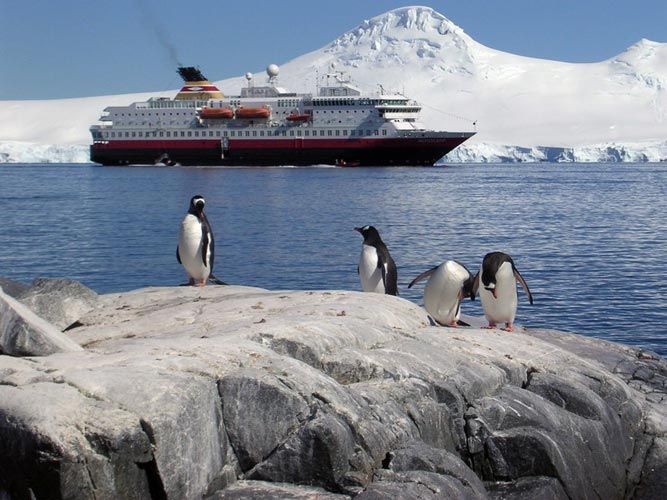
5. According to the International Association of Antarctic Tour Operators (IAATO) the numbers of people visiting the 7th continent during the most recent summer season has dropped way off its high of 46,265 people in 2007-2008. Last season – 2010-2011 – the number was less than 34,000. This coming summer, thanks largely to a new ban on heavy fuels which will prohibit most big cruise ships from visiting the Peninsula, the industry monitoring group anticipates a 25 percent drop, to just over 25,000 visitors. The ban on heavy fuels, imposed by the International Maritime Organization (IMO), goes into effect next month; it is purposely aimed at reducing the number of big ships visiting the Peninsula, the kind that carry thousands of passengers. Big ships + heavy fuel = big trouble in case of an accident, which could be disastrous on many fronts in this most-remote, most-pristine region. Visitor numbers are also down simply due to a still-sour global economy. Even the smaller ships that carry fewer than 500 passengers and make a dozen or more trips to the Peninsula each season are expecting fewer customers in the season, which begins in November.
[Flickr image via Christian Revival Network]