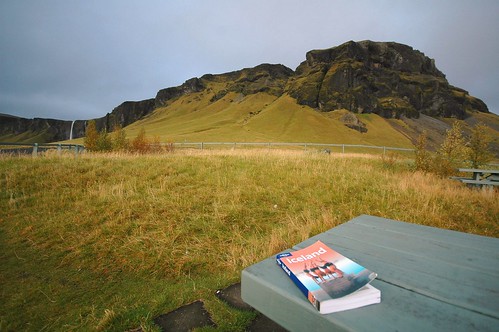
Hidden far away in the North Atlantic, Iceland may seem like one of the last outposts for globalization to reach. One economist stressed that a century ago, Iceland was essentially Ghana in terms of economic development. And even as late as the 1970s, Iceland still remained one of the poorest countries in Western Europe, with a major portion of its economy reliant on fishing. Yet today, Iceland is, according to the United Nations Human Development Index, the most developed country in the world, with one of the highest rates of life expectancy, literacy, and per capita GDP.
So how has Iceland gotten where it is today and what exactly went wrong in the last month?
The answer to both is financial globalization. The very forces of global integration, which led to deregulation of the banking sector and creation of a national stock exchange, nearly pushed this distinctly first-world country a few weeks ago into “national bankruptcy,” in the words of Prime Minister Geir Haarde.
What’s really scary is that the on-going Icelandic crisis has been in large parts an external crisis of confidence. Its three major banks were quite well-behaved, with little exposure to the “toxic” subprime loans we’ve all heard so much about. But ultimately foreign lenders to Iceland’s banks did not see the government as a credible lender of last resort. In other words, although the banks were too big to fail, they were also too big to bail (out).
On many fronts, Iceland’s economic report card is sparkling clean: the country boasts of a fully-funded pension, a strong financial regulatory agency, low unemployment, and high growth. In particular, Iceland’s banks have become a success story for financial integration, having fueled much of the country’s economic growth in the past decade. While the fishing industry’s share of GDP declined from 16% in 1980 to 6% in 2006, the finance, insurance, and real estate industries together saw an increase from 17% of GDP to 26% in the same period.
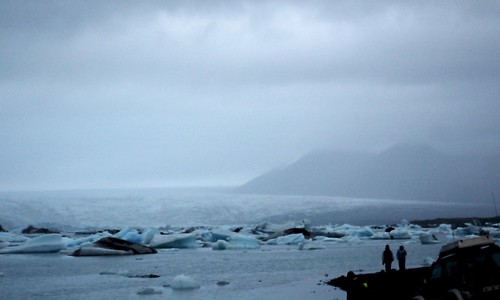
However, with a population of 300,000, or roughly one-fifth the population of Manhattan, this tiny island did not have the internal capital to support growth in the financial sector-they had to seek financial integration with the global system. Thus, these newly privatized banks quickly began to access foreign credit (and customers) in Scandinavia, the US, Japan, Canada, Australia, and the UK. One now-infamous Icelandic bank, Landsbanki, started IceSave, an UK-based Internet bank, in October 2006, which accumulated £7.3 billion deposits from 300,000 British and Dutch accounts. By the first quarter of 2008, assets of Icelandic banks had ballooned to 14,069 billion ISK (Icelandic krona) or $176 billion, roughly eleven times the size of the country’s 2007 GDP.
Though financial liberalization enabled capital to flow easily into the country, capital was able to flow out just as easily. Investors saw the country, even with its strong financial fundamentals, as the weakest link of the ongoing global financial crisis.
The most dramatic consequence of the collapse and subsequent nationalization of the big three Icelandic banks could be seen in the UK, where the British government had to resort to anti-terrorism laws to freeze $6.8 billion in Icelandic assets.
Iceland’s meltdown presents potential consequences beyond the global financial sector. Many of its domestic companies are now multinational corporations that depend on a viable currency regime and access to foreign credit for continued operation. Two particularly prominent businesses are Actavis and the Baugur Group. In the 1990s, Actavis, a generic-producing pharmaceutical, had less than 100 employees and served only the Icelandic market.
Now the company is active in 40 countries and employees 11,000 people. Its collapse would produce a spillover effect that could cause other associated businesses to go bankrupt. The greatest possibility of this domino theory at work is with Baugur Group, which directly owns a large number of UK retail conglomerates, including Woolworth’s and Somerfield (as well as an equity stake in Saks Fifth Avenue).
Ultimately, on October 25, Iceland became the first Western country since 1976 to accept an International Monetary Fund (IMF) bailout. Discussions are now on-going for an additional $4 billion loan by Norway, Sweden, Finland, and Denmark (after initial talks with Russia came under harsh fire).
Paradoxically, greater financial liberalization must be pursued to salvage Iceland’s economy. With its banking sector’s sheer size in comparison to the national economy, Iceland must abandon the krona in favor of the euro, as the EU is a much more credible lender-of-last-resort than the government of a small Scandinavian island.
One hedge fund manager earlier this year described the almost sure-fire profit of shorting Iceland as the “second coming of Christ.” Ironically, through the financial integration of the 1990s, the island’s banking sector had itself turned into a sort of bizarre hedge fund, with an enormous asset-liability mismatch to the size of the underlying economy.
Granted, although the three banks’ fundamentals were relatively strong, with little exposure to subprime securities, they were ultimately early victims of the global credit crunch. With no wholesale credit to roll over their loans, they had to be nationalized, which set off a chain-reaction of events that impacted the UK, Germany, and several other nations across the globe. Now, paradoxically, more financial integration, in the form of Iceland moving from the krona to the Euro, is needed in order to stave off another banking crisis and for long-term stability and growth of the Icelandic economy.
So what does all this mean to a seasoned traveler like you?
- Book yourself on the next flight to Iceland. The krona has fallen in value by half over the last couple months. That means a national 50% off sale.
- But this joyride may be over soon. The IMF $2 billion bailout is designed to stabilize their currency. Translation: things will cost more.
- Set your net wider. Other European countries, particularly Hungary, Ukraine, Spain, and Germany, are financially weak right now.
- And whatever you do, don’t put your money in an Icelandic bank. Even if they offer you a small village as collateral.